What We Do: Investigations

Salmon Pueblo as a Unique Place

Virtual Reconstruction of Salmon Pueblo

Virtual reconstruction of Salmon Pueblo

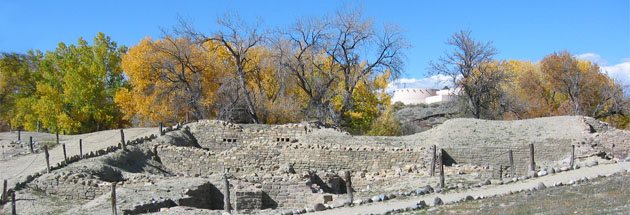
Salmon Ruin occupies a unique place in ancient Puebloan history. The site was built along the San Juan River at the end of the Chacoan florescence, as Chacoan groups spread northward in the late 1000s. Salmon represents the first large-scale Chacoan pueblo built north of Chaco Canyon. Other sites in the north may have been built earlier—Wallace, Lowry, and Chimney Rock in southwestern Colorado, for example—but no other sites of comparable size and scale were constructed prior to 1090. Salmon’s establishment by the Chacoans was quickly followed by Aztec’s West Pueblo between 1105 and 1115. Aztec apparently carried the Chacoan mantle throughout the 1100s and into the 1200s; Chacoan buildings continued to be constructed at Aztec during these centuries. In contrast, Salmon’s architecture made a complete transition after the 1120s, and no additional Chacoan masonry was added during the remainder of the site’s history.

The founding of Salmon around 1090 represents a watershed in the history of the Middle San Juan region. The shift northward from Chaco Canyon has been attributed to various factors, including changing climatic conditions in the late 1000s. Chaco continued as one of the primary centers of ancient Puebloan life into the early 1100s and beyond. Nevertheless, the communities built in the Middle San Juan region, such as Aztec and Salmon, and those built farther north in the greater Mesa Verde region, indicate a change in the focus of activities and a broader geographic spread of Chacoan and post-Chacoan culture by the early 1100s. Salmon and Aztec were deliberately built in fertile alluvial valleys next to some of the largest rivers in the northern Southwest. Given the development of water-management techniques in Chaco during the 1000s, it is not surprising that Chacoan movement northward focused on areas where these newly developed technologies could be implemented on a larger scale. Indeed, the available evidence indicates that both Salmon and Aztec produced large quantities of corn; in the case of Salmon, some of this corn may have been exported as ground meal. Further, the area around Aztec has evidence of at least two ancient irrigation ditches, first documented by John Newberry during an 1859 expedition.

Salmon was built as a residential Chacoan site around 1090, and was occupied by Chacoans until the 1120s. After Chacoan leadership at Salmon ended, the pueblo began a transition to a local San Juan settlement. Irwin-Williams thought that the drought that began around 1130 factored in the decline of Chacoan society—not only in the canyon, but also across the San Juan Basin. Certainly, the drought played a role; however, changes at Salmon began in the 1110s and 1120s, prior to the onset of the drought. Preservation Archaeologist Paul Reed has suggested that local conditions may have caused the Chacoans to leave Salmon, and find their way to Aztec’s East Ruin in the 1120s.

One challenge faced by Salmon’s residents throughout its history was flooding of the San Juan River. Evidence of ancient flooding was found during excavations at Salmon, with flood deposits in rooms on both the southwest and southeast corners, and in the great kiva. Further, the latter structure was re-roofed and perhaps entirely rebuilt in the mid-1260s. The final form of the great kiva included a high (perhaps 2 meters) cobble-and-dirt berm encircling the structure, which functioned as a flood-control facility.

Reed believes that the power of the San Juan River was greater than the Chacoans had anticipated. At about 200 meters, Salmon was built too close to the river during a period of drought in the late 1080s and early 1090s when the flow was lower than average. When the river returned to full discharge, the Chacoans at Salmon realized their mistake. In comparison, Aztec West—initiated around 1105 and complete by 1120—was built more than 400 meters from the Animas River, a stream with a discharge and flow no more than half that of the San Juan. Reed has hypothesized that the Chacoan core group at Salmon, realizing that the location of Salmon would not meet their needs, moved to Aztec after 1120 and helped to build Aztec East, the symmetrical partner to Aztec West.

The mid- to late 1100s were a relatively quiet time at Salmon. Earlier archaeologists described an abandonment of the pueblo, but their interpretation is not supported by the most recent data, which indicates that Salmon continued to be occupied by local Puebloans—part of the original founding group at the site. With Chacoan leadership gone, however, these folks were free to modify the pueblo according to their own needs. Thus, we can document the conversion of Salmon’s large, square living rooms to kivas; room 96W was apparently the first to be converted in the 1120s. Other rooms followed in the mid- to late 1100s. By the mid-1200s, more than 20 kivas had been built into rooms at Salmon and placed into the plaza at several points. The need for so many kivas highlights social and ceremonial differences between these local San Juan groups and the earlier Chacoan residents. We thus have continuity through the 1100s at Salmon, with residents and their descendants recruited by the Chacoans to help build and live at the site in the late 1000s continuing in residence.

The 12th-century residents of Salmon were subsequently joined by other local residents and people from the Middle San Juan region surrounding Salmon (particularly, from areas upstream to the east and north). From about 1190 to the 1280s, developments similar to those in the north, in the Mesa Verde region, occurred. In contrast to the original interpretation of the 1200s at Salmon, however, we no longer view migration from the north as the primary cultural influence. Certainly, people migrated to and from many areas of the ancient Puebloan Southwest in the 1200s (and in other times). However, evidence from architecture and ceramics at Salmon does not indicate a massive migration of people from the north. Instead, 13th-century Salmon fits within the larger cultural context for architecture (with San Juan–Mesa Verde-style kivas and cobble construction) and ceramics (with local versions of the widespread pottery types of the era, McElmo and Mesa Verde Black-on-white).