 EVENT: Mule Creek and the Post-Mimbres Archaeology of the Upper Gila, a presentation to the Santa Cruz Valley Chapter of the Arizona Archaeological Society
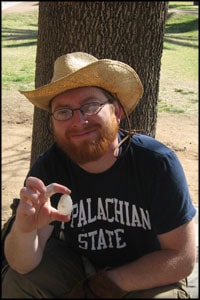
PRESENTED BY: Rob Jones, Center for Desert Archaeology Preservation Fellow and graduate student of the University of Arizona School of Anthropology
DATE/TIME: Thursday, February 10, 2011, at 7:00 p.m.
LOCATION: North County Facility, 50 Bridge Road, Tubac, Arizona
ADMISSION: Free and open to the public
ABOUT THE PRESENTATION: Rob’s talk will focus on recent work conducted by the Center for Desert Archaeology and others into the post-1200s occupation of the Upper Gila watershed. Three seasons of field work in Mule Creek, a tributary of the San Francisco, have shed new light on the culture history and community connections of the final Puebloan occupation of the area. Beginning in the 1200s, the Upper Gila was home to diverse communities exploiting the abundant natural resources of the area, including the Mule Creek obsidian source. Using survey and excavation data, obsidian source provenience and ceramic compositional studies, this ongoing project seeks to reconstruct the place of the Upper Gila communities in the greater southwest during the florescence of the Salado phenomenon.
ABOUT ROB JONES: Rob Jones is a graduate student at the University of Arizona, and a Center for Desert Archaeology Preservation Fellow. Rob got his B.A. at the University of Georgia, where he worked on Mississippian archaeology and historic period hand tool technologies. He has worked in contract archaeology in South Carolina and Arizona, and recently completed his masters at the University of Arizona, entitled “A Reevaluation of the Point of Pines Phase,” which examined the final Puebloan occupation of the Arizona mountains through ceramic technology. His most recent work has focused on the 13th- and 14th-century occupation of the Upper Gila region of Arizona and New Mexico.
He has spent two summers as Field Director for the Mule Creek Archaeological Testing Project, working on several sites in the Upper Gila. His research on obsidian networks and the Salado phenomenon is part of the Center for Desert Archaeology’s research program into the late prehistoric archaeology of the southern Southwest. It will form the basis for his forthcoming dissertation.